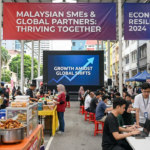


The morning coffee tastes a little different when you’re staring at an invoice that’s 20% higher than last month. It’s a feeling many Malaysian business owners are becoming all too familiar with. The whispers of global trade wars, tariff hikes, and shifting economic policies are no longer distant news reports; they are real-world pressures knocking on our doors. These international shifts create ripples that travel across oceans and land right in our local economy, affecting everything from the cost of raw materials to the purchasing power of our customers. Here, we’ll explore this new landscape and offer a practical guide. We will look at what is happening globally, learn from others, and map out a clear path for Malaysian businesses to not just weather the storm, but to sail through it with confidence.
The Global Ripple Effect in Malaysia
It’s easy to think of global economics as something that happens ‘over there’. But the reality is that a policy decision made in Washington or Beijing can directly impact a small manufacturer in Penang or a café in Kuala Lumpur. We are seeing this happen in real-time. The most immediate challenge is the rise in operational costs. Tariffs slapped on goods mean imported components or finished products become more expensive. Add to that the rising shipping costs and a fluctuating Ringgit, and suddenly, profit margins that were once healthy are now razor-thin. It’s a chain reaction: the cost of your supplies goes up, and you’re faced with the tough choice of either absorbing the cost or passing it on to your customers, risking your competitive edge.

Lessons from International Playbooks
Malaysian businesses are not alone in this fight. Small and medium enterprises (SMEs) across the globe are facing similar headwinds. By looking at how they are adapting, we can gather valuable insights. For instance, many small businesses in Europe, faced with supply chain disruption, have started ‘near-shoring’ – finding suppliers closer to home, even within their own country. This reduces their dependence on long-distance shipping and insulates them from geopolitical tensions in any single region. Others have doubled down on technology, not complex AI, but simple, effective tools. Think inventory management software that reduces waste or customer relationship systems that help retain loyal patrons. The key lesson is proactivity. They aren’t waiting for the storm to pass; they are actively adjusting their sails.
Proactive Finances: Your Business’s Shield
When uncertainty is high, cash is king. Reactive financial decisions, like cutting costs frantically when a crisis hits, can do more harm than good. Instead, the focus must shift to proactive financial planning. This is the cornerstone of effective Malaysian SME financial management. It starts with having a crystal-clear view of your cash flow. We recommend forecasting your income and expenses for at least the next six to twelve months. This allows you to spot potential shortfalls early and make informed decisions. Beyond forecasting, it’s about building a financial buffer. Regularly setting aside a portion of your profits into an emergency fund can provide the stability needed to navigate a few tough months without having to take on high-interest debt.

Exploring Your Financing Options
The traditional bank loan isn’t the only path to securing capital anymore. While it remains a viable option, the landscape of business financing in Malaysia has grown. It’s important for SMEs to explore these alternative avenues. Peer-to-peer (P2P) lending platforms, regulated by the Securities Commission Malaysia, connect businesses directly with investors, often offering faster and more flexible financing. Similarly, equity crowdfunding allows you to raise funds by selling small stakes in your company to a number of investors. There are also numerous government grants and soft loan schemes offered through agencies like SME Corp Malaysia and PUNB, designed specifically to support local enterprises. Diligent Malaysian SME financial management involves knowing all the options available to you, not just the most obvious one.
Building an Agile and Resilient Business
In today’s economy, the strongest businesses are not the biggest, but the most agile. Agility is the ability to pivot quickly in response to market changes. One of the most powerful small business survival strategies is diversification. Have you considered expanding your customer base beyond your local neighbourhood? An online store can open your products up to the entire country, or even the Southeast Asian region. Can you diversify your revenue streams? For example, a restaurant could start selling its popular sauces or offer cooking classes. Another key strategy is to build a resilient supply chain. Relying on a single supplier is risky. Start identifying and building relationships with alternative suppliers, preferably from different regions, to protect your business from future disruptions.
The current economic climate is undoubtedly challenging, but it is not a death sentence for the ambitious Malaysian SME. It is a call to action. The era of simply ‘business as usual’ is over; it’s time to become more strategic, more informed, and more resilient. By understanding the global trends, we can anticipate the local impact. This is where a focused approach becomes critical. Mastering your cash flow, exploring diverse financing options, and building an agile business model are no longer just good ideas—they are essential components for success. In essence, strong small business survival strategies are built on the foundation of smart financial planning. Embracing these principles is how we move from a position of defence to one of offence, turning uncertainty into opportunity and ensuring our local businesses not only survive but truly thrive.