
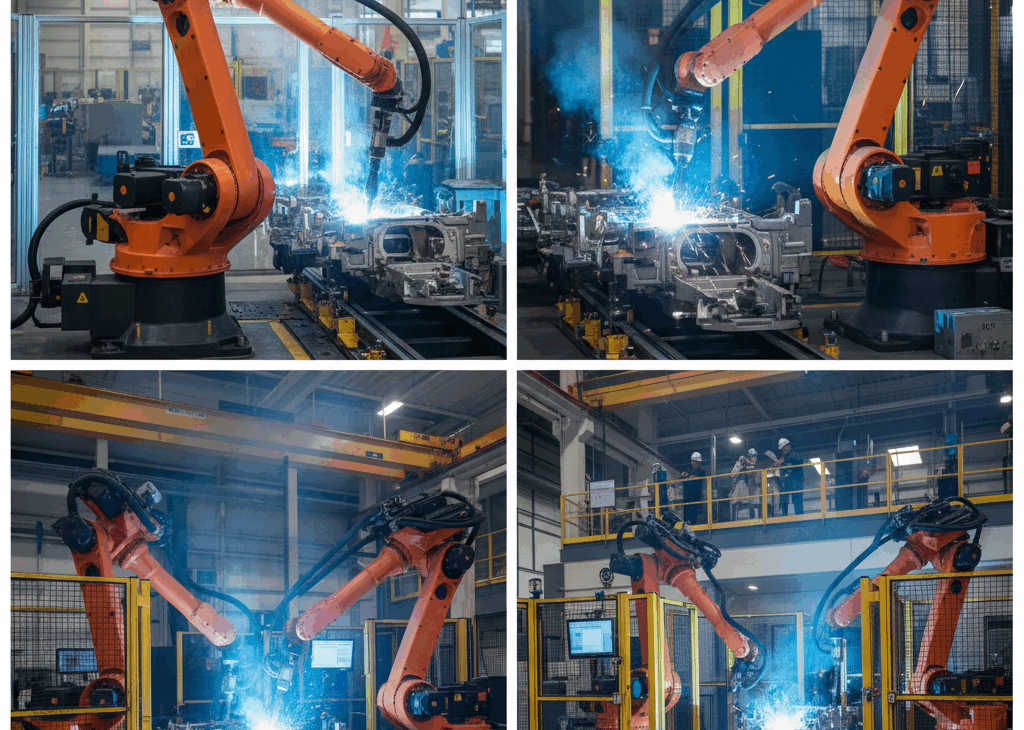
In a modern manufacturing world that is highly dynamic and competitive, throughput and regularity of the manufacturing process is what counts towards gaining a competitive advantage. The application of robot welding machines is one of the most effective developments of industrial automation. The advanced systems are changing the way welding is done in various industries such as automotive, aerospace among others by increasing productivity, quality and saving on operational costs.
This paper is presented in the spirit of demonstrating how robotic welding machines can greatly increase your productivity in the workplace.
1. The speed and efficiency are increased.
The robotic welding machines are capable of working for a long time without the necessities of taking a break, rest, or changing shifts. Robotic systems are fast and steady in every task unlike human welders who require rest and may slow down and be erratic in the speed and accuracy of their work.
Shorter production cycles
Higher output rates
Product accelerated time-to-market.
As menial and time-intensive work will be performed by the robots, your production line will be able to reach a higher throughput without sacrificing quality.
2. Uninterrupted and Excellent Welds.
The human welding is a variation- variation of the human hand steadiness, positioning and concentration may influence the quality of the weld. The welding machines which are robotically controlled, however, are guided by high precision pre-programmed paths and parameters, with the result that:
Regular bead looks of the welding in appearance.
Fewer defects and rework
Strengthening and enhancing welds.
Consistency does not only enhance the quality of product, but also minimizes wastes and unnecessary quality checks or subsequent process.
3. Reduced Labor Costs
Although cost of initial investment into the robotic welding technology may be high, it is worth it in the long run. Automation of welding activities by companies can:
Lower the supply of skilled welders to be used in repetitive work.
Reduced cost of recruitment and training.
Redistribute human labor to more skills and high value jobs.
This economical nature translates into better productivity in terms of dollars invested on labor.
4. Enhanced Worker Safety
Welding may put a worker at risk of harmful fumes, excessive heat and burns or eye damage. Multi-joint robot welding systems eliminate human operators to these hazardous workplaces, and they are helpful:
Reduce occupational accidents.
Cut insurance and compensation expenses.
Enhance employee morale and retention through provision of a safer place to work.
5. Flexibility in Production
The contemporary robotic welding systems are very versatile. They are programmable and can be fitted with different tools to accomplish a wide range of welding jobs, materials and the size of parts. Such flexibility enables manufacturers to:
Rapid product type or custom order switching.
React to the market quicker.
Reduce the time that is not spent in production between productions.
This flexibility means that your welding operation is also responsive and will be agile, which is essential in the current dynamic manufacturing environment.
6. Monitoring and Data Collection
Most robotic welding machines are fitted with sensors and programs that enable them to monitor their performance and quality in real-time. This is a data-based solution that allows:
Errors are immediately detected and corrected.
Continuous process improvement.
Predictive maintenance to prevent the unexpected failures.
Through data, you will be able to make smarter decisions that will continue maximizing productivity.
Conclusion
Robotic welding machines are not a futuristic invention anymore, it is a realistic and a well-tested technology that can be used by companies to expand and enhance efficiency. Robotic welders will affect human workers by releasing them to do more strategic tasks and improving the efficiency and quality of the welding process through the provision of speed, precision, consistency, and safety.
With the growing level of competitiveness in manufacturing, making the upgrade to robotic welding systems is not merely the case of upgrading, but rather a case of survival.